

The Community Within
Vol. 1

Introduction
This week’s short tips will be a series that discusses the idea of community. We treat community as a monolith, but it’s so complex and nuanced. Think about your family, the one you belonged to as a child, and if they’re different, the one you belong to now. Are there interfamily ‘communities’ within your family? Tiny communities that have their own values and customs? Growing up, my brothers, mom and I were a community, but within that community, there existed a separate community of just us sons.
I’ll get lost in the nuance if I try to parse out all of the different bonds within our communities. This series will explore these types of communities: individual, family, and neighborhood.
At home, we’ve been discussing community for months. Ever since we watched Blue Zones, on Netflix. We’re even hosting an informal get together at a local coffee shop to discuss the idea of community. This is important, the United States is experiencing a loneliness epidemic according to the U.S. Surgeon General; New Surgeon General Advisory Raises Alarm about the Devastating Impact of the Epidemic of Loneliness and Isolation in the United States.
This post is going to be rife with questions. But I hope you realize that like you, I’m in search of answers. Let’s start by defining ‘community’. The dictionary definition of community lacked some attributes I felt were too important to do without. I found a definition here that I like much more, https://othersociologist.com/2013/11/20/sociology-of-community/
Community
A social group who follow a social structure within a society (culture, norms, values, status). They may work together to organise social life within a particular place, or they may be bound by a sense of belonging sustained across time and space.
@Sociology At Work
Now that we’ve covered the introduction let’s move on to community and the individual.
Individual: The Community Within
Before we get started, I have a question for you. Can you list 5 of your values in a minute or less? If not, no worries. They should take some time to consider, if you can then I suspect you’ve taken the time to contemplate your values. Even figuring those out can be a chore, and with good reason! Our personal values themselves may be a result of internal interpersonal relationships. Have you heard of Internal Family Systems and Positive Intelligence?:
The Internal Family Systems model discusses three core parts that play their own roles
Managers, protective parts that function to control people’s surroundings and manage emotions and tasks to navigate daily life.
Exiles, parts that hold hurt, fear, or shame from early experiences, and they carry the difficult emotions and memories associated with those experiences.
Firefighters activate when exiles produce overwhelming, painful, or threatening emotions.
In the book (Positive Intelligence,Chamine, 2012) The author discusses the impact of having 11 personalities in our mind.
The Sage is responsible for empathy, exploration, innovation, navigation, and activation.
The Judge “beats you up repeatedly over mistakes or shortcomings, warns you obsessively about future risks…”
The Judge’s nine accomplices can be seen below, there’s even an assessment that will show you your top saboteurs: Positive Intelligence.
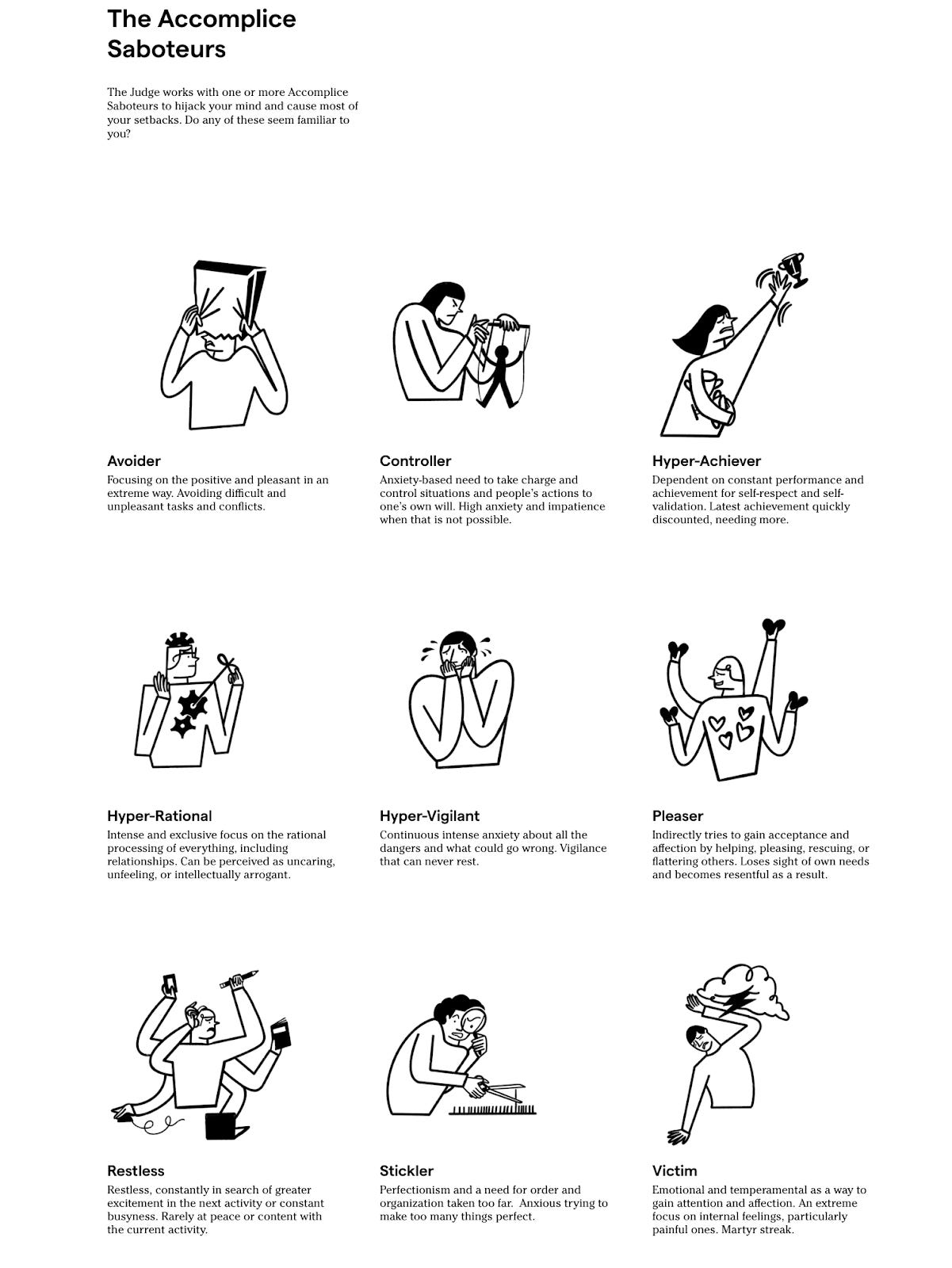
We have a lot going on, right? Would we build more authentic, stronger, and wholesome relationships if we investigated our own values and learned to communicate with, and integrate, the potentially many parts of ourselves? With or without professional help.
Once we’re clearer on what our values are and what our different parts are like, we can find those places that feel like home and show up in a way that’s edifying for us and for the community.
What do you think?
I have a stickler sabateour, definitely!